Healing from Toxic Motherhood: A Faith-Based Guide to Breaking Free and Reclaiming Your Power
If you grew up with a mother who couldn’t love you the way you needed—or worse, who actively hurt you—you already know the wounds run deep. The self-doubt. The people-pleasing. The belief that you’re somehow fundamentally broken or unworthy. These aren’t just feelings. They’re scars left by toxic motherhood.
But here’s the truth: your mother’s wounds don’t have to become your legacy. Healing from toxic motherhood is possible. Furthermore, you don’t have to do it alone.
In this guide, I’ll walk you through what toxic motherhood actually means, how to recognize the signs you’re carrying maternal wounds, and most importantly, how to heal through faith-based practices that honor your whole self—body, mind, and spirit.
What Is Toxic Motherhood?
Toxic motherhood isn’t about mothers who made mistakes or had bad days. We all have those. Instead, toxic motherhood is a pattern of behavior where a mother consistently fails to meet her child’s emotional needs—or actively harms them through manipulation, control, emotional abuse, neglect, or conditional love.
Recognizing the Patterns
Toxic motherhood can show up as emotional manipulation, where she uses guilt, shame, or the silent treatment to control you. You feel like you’re constantly walking on eggshells, never knowing which version of her you’ll get. Additionally, it can manifest as narcissistic personality disorder or behavior, where everything revolves around her—your feelings, needs, and accomplishments get dismissed or turned into opportunities for her to talk about herself.
Sometimes it looks like conditional love, where her affection feels earned rather than freely given. You have to perform, achieve, or behave a certain way to receive approval—and even then, it’s never enough. Toxic motherhood often involves boundary violations, where she doesn’t respect your privacy, autonomy, or right to say no. She sees you as an extension of herself, not as your own person.
The Spectrum of Harm
For some, it manifests as emotional neglect—she was physically present but emotionally absent. You learned early that your feelings didn’t matter, so you learned not to have them. In the most severe cases, toxic motherhood includes overt abuse such as verbal, physical, or sexual harm—behaviors that are undeniably damaging and traumatic.
If you recognize any of these patterns, you’re not alone. Moreover, you’re not imagining it. Toxic motherhood is real, and it leaves lasting wounds.
The Wounds Toxic Motherhood Leaves Behind
When you grow up with a toxic mother, you don’t just walk away unscathed. Instead, the wounds she left become part of your inner architecture—shaping how you see yourself, how you relate to others, and how you navigate the world.
The Self-Worth Battle
Self-worth becomes a constant struggle. No matter what you achieve, it never feels like enough. You question whether you’re lovable, valuable, or deserving of good things. Because of this conditioning, you become a chronic people-pleaser—you’ve learned that love is conditional, so you contort yourself to meet everyone else’s needs, often at the expense of your own.
The Boundary Crisis
Setting boundaries feels impossible because saying “no” triggers fear of rejection, abandonment, or conflict. Consequently, you say “yes” even when it depletes you. You may find yourself unconsciously attracting toxic relationships, recreating the dynamics you grew up with in your partnerships, friendships, or professional relationships.
The Shame You Carry
Additionally, you carry shame that isn’t yours, having internalized the message that you’re the problem—that if you were just better, quieter, more successful, more compliant, she would have loved you right. If you’re a mother yourself, you might struggle with either over-functioning to the point of burnout or feeling paralyzed by the fear of repeating the cycle.
These wounds are real. They’re not your fault. However, they can be healed.
Why Healing from Toxic Motherhood Is So Hard
Healing from maternal wounds is uniquely difficult because of the primal nature of the mother-child bond. We’re wired to seek our mother’s love and approval. Therefore, when that love gets withheld, conditioned, or used as a weapon, it creates a deep fracture in our sense of self.
Cultural and Religious Pressures
Cultural and religious pressures make it harder. You’ve been told to “honor your mother,” to forgive and forget, to keep the peace. But honoring someone doesn’t mean accepting abuse. Similarly, forgiveness doesn’t require reconciliation or pretending the harm didn’t happen.
The Gaslighting Effect
Gaslighting compounds the difficulty—toxic mothers are often master manipulators who rewrite history, deny their behavior, and make you question whether the abuse even happened. “I never said that.” “You’re too sensitive.” “You’re remembering it wrong.”
The Complicated Grief
The grief is complicated because you’re not just grieving the mother you had. Instead, you’re grieving the mother you should have had—the one who protected you, cherished you, and made you feel safe. That’s a loss that never fully goes away.
But here’s what I know from my own journey and from walking with countless women through theirs: healing is possible. It’s not easy. It’s not linear. However, it’s possible.
The Path to Healing: A Faith-Based Approach
Healing from toxic motherhood requires a holistic approach that addresses your spiritual, emotional, and physical wounds. You can’t just “think” your way out of trauma. Instead, you have to feel it, process it, and release it—with God’s help and your own agency.
1. Acknowledge the Truth
Healing begins with honesty. You have to name what happened. Additionally, you have to stop minimizing, justifying, or explaining away her behavior. This is especially hard for women of faith because we’ve been taught to honor our parents, to forgive, to turn the other cheek. But God never asks you to call abuse “love.” He never asks you to sacrifice your well-being to protect someone else’s image.
You can honor the position of “mother” without honoring abusive behavior. These things are not the same. When you sit down to journal, ask yourself: What truths have I been avoiding about my relationship with my mother? What would it feel like to name them out loud? This is where your healing journey begins—in the courage to tell the truth.
2. Release the Shame That Isn’t Yours
Toxic mothers often project their own shame onto their daughters. Consequently, you’ve been carrying guilt, inadequacy, and unworthiness that were never yours to carry. Here’s the truth you need to hear: You are not the problem. You never were. Her inability to love you well says everything about her wounds—and nothing about your worth.
Scripture tells us clearly: “There is now no condemnation for those who are in Christ Jesus” (Romans 8:1). You are not condemned. You are not broken beyond repair. Furthermore, you are not unlovable. Those are lies planted by someone who couldn’t see your light.
Take time to write down every lie you’ve believed about yourself because of her. Then write God’s truth next to each one. Speak the truth out loud until it begins to replace the lie. This is the work of reclaiming your identity.
3. Grieve What You Lost
You need to grieve. Not just the mother you had, but the mother you deserved. The childhood you should have experienced. The version of you that might have existed if you’d been loved well. Grief is not weakness. Instead, grief is holy work.
Give yourself permission to feel the sadness, the anger, the confusion. Don’t rush this process. Similarly, don’t spiritualize it away with premature forgiveness or toxic positivity.
Jesus wept (John 11:35). He didn’t push past His grief. He felt it fully. You can too. Set aside time to grieve intentionally. Light a candle. Play music that moves you. Write letters you’ll never send. Let the tears come. This is sacred work, and it’s essential to your healing.
4. Set Boundaries (Even with Your Mother)
Boundaries are not ungodly. Instead, boundaries are stewardship. You are the steward of your peace, your body, your time, and your well-being. Therefore, setting boundaries with your mother—whether that means limiting contact, going no-contact, or simply refusing to engage in certain dynamics—is not dishonoring. It’s self-preservation.
Scripture is clear: “Above all else, guard your heart, for everything you do flows from it” (Proverbs 4:23). Guarding your heart means protecting it from ongoing harm. That’s not selfish. That’s wisdom.
Boundaries might look like limiting phone calls or visits, refusing to discuss certain topics, not allowing her to speak negatively about you to others, or going low-contact or no-contact if necessary. Remember this truth: You don’t owe anyone access to you—not even your mother.
5. Reparent Yourself
One of the most powerful parts of healing is learning to give yourself what she couldn’t give you. This is called “reparenting”—and it’s not selfish. It’s essential.
Reparenting means speaking to yourself with kindness and compassion, meeting your own needs without guilt, celebrating your wins both big and small, comforting yourself when you’re hurting, and setting boundaries without shame. Essentially, you become the mother you needed.
When you notice negative self-talk, pause and ask yourself: “Would I say this to a child I love?” If not, don’t say it to yourself. Instead, speak to yourself the way God speaks to you—with love, grace, and truth. This daily practice will transform how you see yourself and how you move through the world.
6. Seek Support
You can’t heal alone. Toxic motherhood thrives in isolation. However, healing happens in community. Find people who believe you, who don’t gaslight or minimize your experience, who understand trauma and healing, and who hold space for your grief without rushing you to “get over it.”
This might be a therapist, a support group, a trusted friend, a pastor, or a faith-based life coach. Find your people. Let them witness your becoming.
7. Reclaim Your Identity in Christ
Your mother’s voice doesn’t get to define you anymore. You are not what she said you were. You are not the shame she projected. Furthermore, you are not the disappointment she made you feel like. You are a daughter of the King.
Scripture declares: “See what great love the Father has lavished on us, that we should be called children of God! And that is what we are!” (1 John 3:1). God’s love is not conditional. It’s not earned. Instead, it’s lavished. Freely given. Unconditional. Unshakable. You are loved. You are chosen. You are enough.
Spend time in Scripture learning who God says you are. Write down every identity statement you find—beloved, chosen, redeemed, forgiven, treasured. Read them daily until they become louder than her voice. This is how you reclaim your identity from the lies and step into the truth of who you’ve always been.
Moving Forward: What Healing Looks Like
Healing from toxic motherhood doesn’t mean you wake up one day and everything is fixed. It’s a process. A journey. Some days you’ll feel free and powerful. Other days the old wounds will ache. That’s okay. That’s normal. That’s healing.
Signs You’re Healing
You’ll know you’re healing when you can set boundaries without guilt, when you stop seeking her approval, when you recognize the lies she planted and replace them with truth. Additionally, you’ll notice healthier relationships forming around you. You’ll feel more at peace in your own skin. You’ll be able to grieve without being consumed by it. Furthermore, you’ll trust yourself again.
The Truth About Healing
Healing isn’t about erasing the past. Instead, it’s about reclaiming your power in the present and building the future you deserve.
Why I Understand This Journey
I didn’t write Healing Whispers from theory. I wrote it from a desire to heal, be healthy and whole. And most importantly a better mother to my adult son Benjamin.
My relationship with my own mother was complicated, painful, and shaped wounds I carried for decades. Additionally, I spent 16 years as a caregiver—first to my mother, then navigating the loss of my husband to sepsis in 2009. During those years, my body wasn’t my sanctuary. It was my tool for serving others. My needs didn’t matter. My healing didn’t matter. Survival was all that mattered.
I survived sepsis myself three times—in 2016, and twice in 2020. Each time, I walked through death’s door. Each time, I chose life. However, choosing life meant more than just surviving physically. It meant finally choosing myself.
At 57, I made the hardest decision of my life. I had to stop caregiving for my mother because my body couldn’t sustain it anymore. I packed up everything, left Georgia, and drove to Las Vegas to rebuild. Not because I was running away, but because I was finally running toward myself.
That journey—from survival to sovereignty, from depletion to embodiment, from carrying everyone else’s wounds to healing my own—taught me everything I share in Healing Whispers. I know what it’s like to carry maternal wounds. I know the guilt of setting boundaries. I know the grief of the mother you deserved but never had. Furthermore, I know what it means to finally choose yourself after decades of choosing everyone else.
This book is the roadmap I needed but didn’t have. It’s the companion I wished had walked with me through the hardest parts. It’s the permission I struggled to give myself—now extended to you.
You don’t have to figure this out alone. I’ve walked this path. I’m still walking it. Additionally, I’m here to show you that healing is possible, freedom is real, and at any age—even 57—you can choose to become.
A 31-Day Journey to Healing
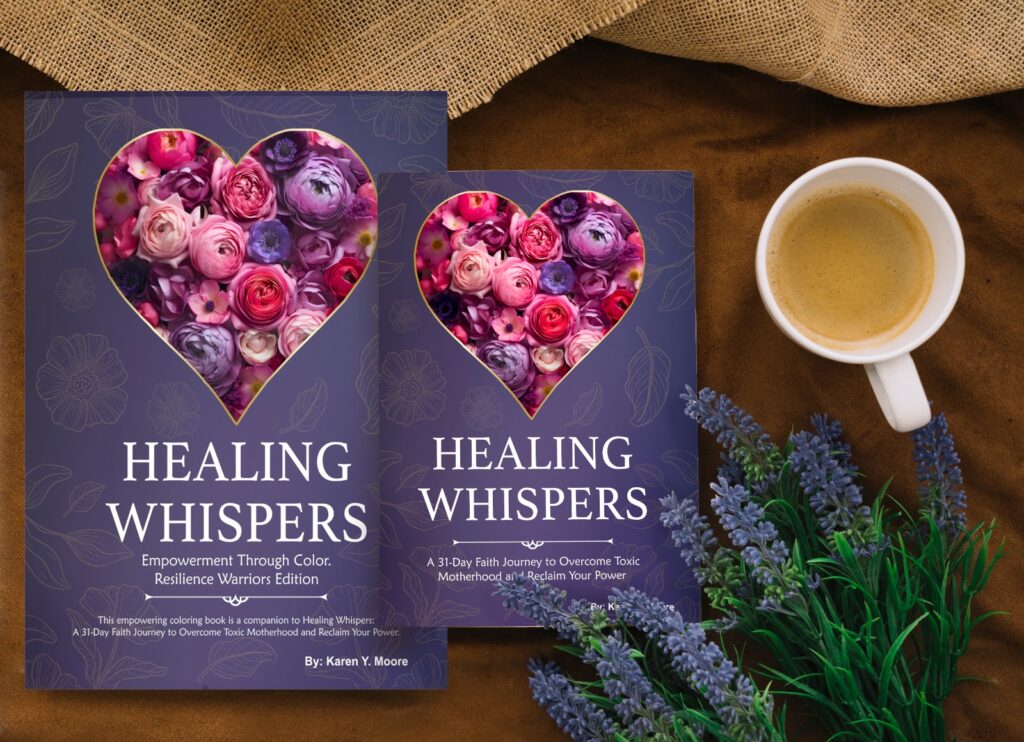
If you’re ready to begin your healing journey, I’ve created a resource specifically to guide you: Healing Whispers: A 31-Day Faith Journey to Overcome Toxic Motherhood and Reclaim Your Power.
This book isn’t just theory. It’s a roadmap. Each day, you’ll receive a healing prayer to connect with God’s restoration, a self-love practice to rebuild your foundation, a self-nourishing ritual to honor your body and spirit, a powerful daily quote to anchor your truth, and a journaling prompt to help you process, release, and transform.
Furthermore, you’ll walk alongside 31 Resilience Warriors—women who’ve survived what you’ve survived and emerged sovereign. They’ll guide you through the pain, hold space for your grief, and show you what’s possible on the other side.
This is for you if you’re ready to stop carrying shame that isn’t yours, if you want to break generational cycles, if you’re done seeking her approval and ready to reclaim your power, and if you need a faith-based framework for healing that honors both Scripture and your lived experience.
Final Thoughts: You Are Not Alone
If you’re reading this and recognizing yourself in these words, I want you to know: you are not alone. Millions of daughters carry maternal wounds. You didn’t cause them. You didn’t deserve them. However, you don’t have to carry them forever.
Healing is possible. Freedom is possible. Peace is possible. Your mother’s wounds don’t have to become your legacy. You can break the cycle. You can reclaim your power. Furthermore, you can become the sovereign woman you were always meant to be. And you don’t have to do it alone.
Ready to begin your healing journey? Explore Healing Whispers: A 31-Day Faith Journey in my shop and start walking toward freedom today.
Have you been healing from toxic motherhood? I’d love to hear your story. I invite you to reach out at [email protected]. You are seen. You are believed. You are not alone.